Preview · Page 1 of 2
Meet the Book
This is the book’s own stage: the island herself — Captain Beechey’s Admiralty chart of 1827–28 and photographs of the rock, the lighthouse and the cellhouse from the years of this book — while a Reader at his desk, an unidentified man in a photograph of the time, captioned as no one but the Reader, reads the reports aloud in Alan’s voice. This preview rides the stage, then hears Alan read the opening of the fiscal year 1915 report fresh, whole. The famous Alcatraz is not in this book — the federal penitentiary of 1934–1963 belongs to a later time, and its words are not yet free to print — and the book says so plainly, on its face. The bookstore barcode rides the preview — scan any moment to come back to this bookstore.
Press Next to see everything that is inside the whole book.
Preview · Page 2 of 2
What’s Inside
- The record, whole: the Disclaimer — then The Name — 1775 and 1826 — The Fort — 1854 to 1870, in Bancroft’s History of California, the engineers’ report of 1858 and the post surgeon’s account of 1870 — The Nineteen — the Hopi Prisoners, 1895 — and The Prison Reports: the commandants’ own annual reports for fiscal years 1909, 1910 and 1911 (Turner), 1912 (Van Vliet), 1915 and 1916 (Howland) and 1918 (Garrard), each one captioned with its writer’s real name as it is read.
- About 5.0 hours of narration — Alan reads the commandants’ own reports aloud, page by page, in a reading room you can follow with your eyes — the reading room carries every section’s full text, numeral tables and all — while the island herself stands on the stage.
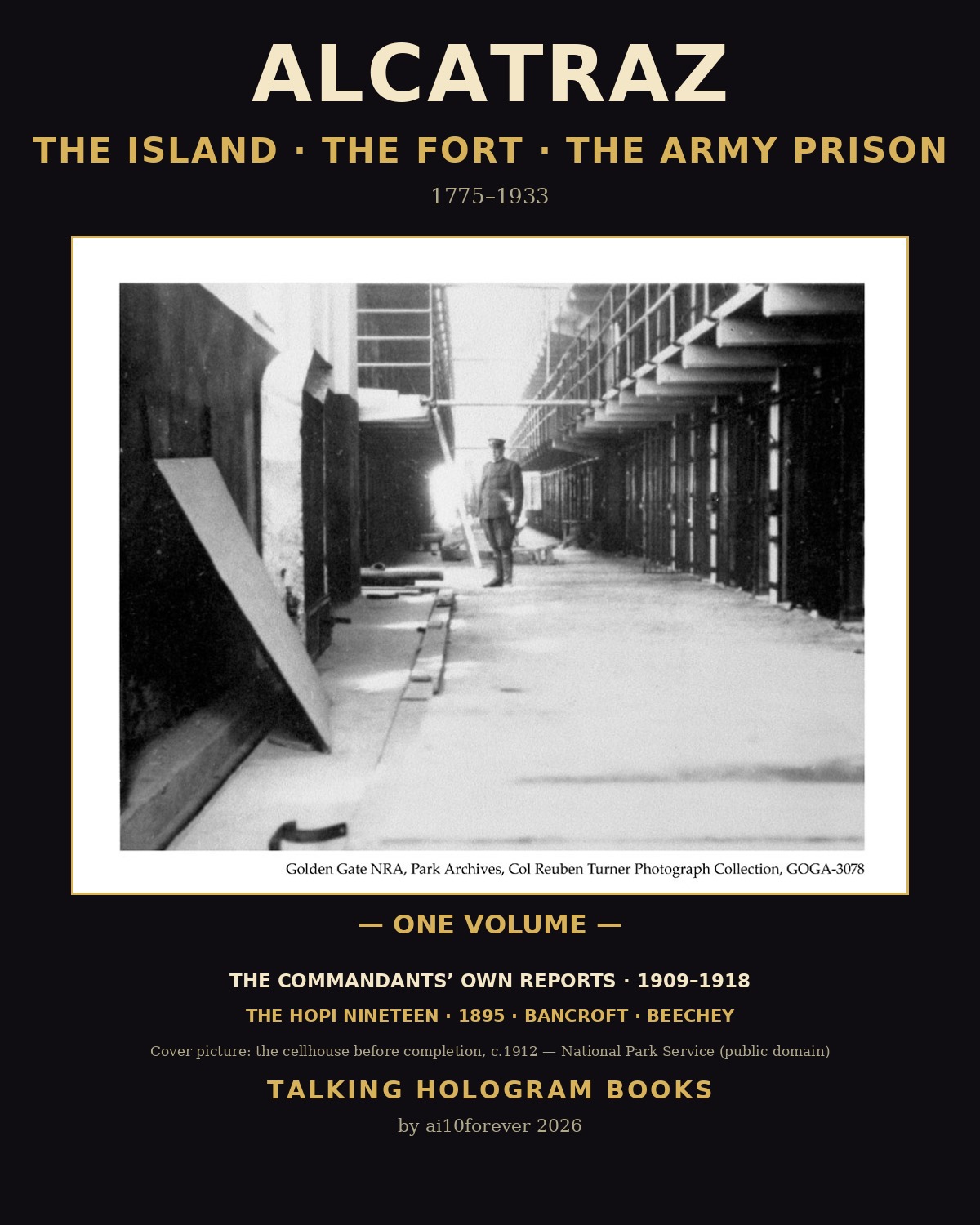
- The book’s pictures — nine public-domain photographs and charts of the time: the island in 1895 and about 1900, the first lighthouse of 1854, the lighthouse and the Citadel with Hopi inmates, the cellhouse of about 1912, the Hopi prisoners of 1895, Beechey’s Admiralty chart, a Detroit Publishing photochrom, and a Watkins stereoview.
This book is a book of the old Alcatraz, and it says so on its face. The island was reserved for military purposes in 1850; its lighthouse, lit on the first of June, 1854, was the first on the Pacific Coast; prisoners were held there from 1859, and the great cellhouse was built in 1912. The famous federal penitentiary of 1934 to 1963 — Al Capone, the Battle of Alcatraz, the escapes — is not in this book, because every word written about it is still under copyright; Philip Grosser’s inside account of the Army prison (1933) misses this house’s hundred-year rule by some seven years, and its absence is named in the book’s disclaimer, so nothing is silently dropped. One chapter carries its label at its head: the nineteen Hopi men of 1895 are heard only in the government’s words — the keepers’ side of the record — because that is all the record of the time contains. The music under the reading is Sousa’s Washington Post March, of 1889, in Prince’s Band’s recording of 1915, kept low beneath the voice. The narration is a synthesized reading (Piper — Alan) of these texts, made for this edition. Editor: Franklin Langston.
franklinlangston.gumroad.com/l/imkoub

Point a camera at this barcode to come straight back to this bookstore — and pass it on.