Preview · Page 1 of 2
Meet the Book
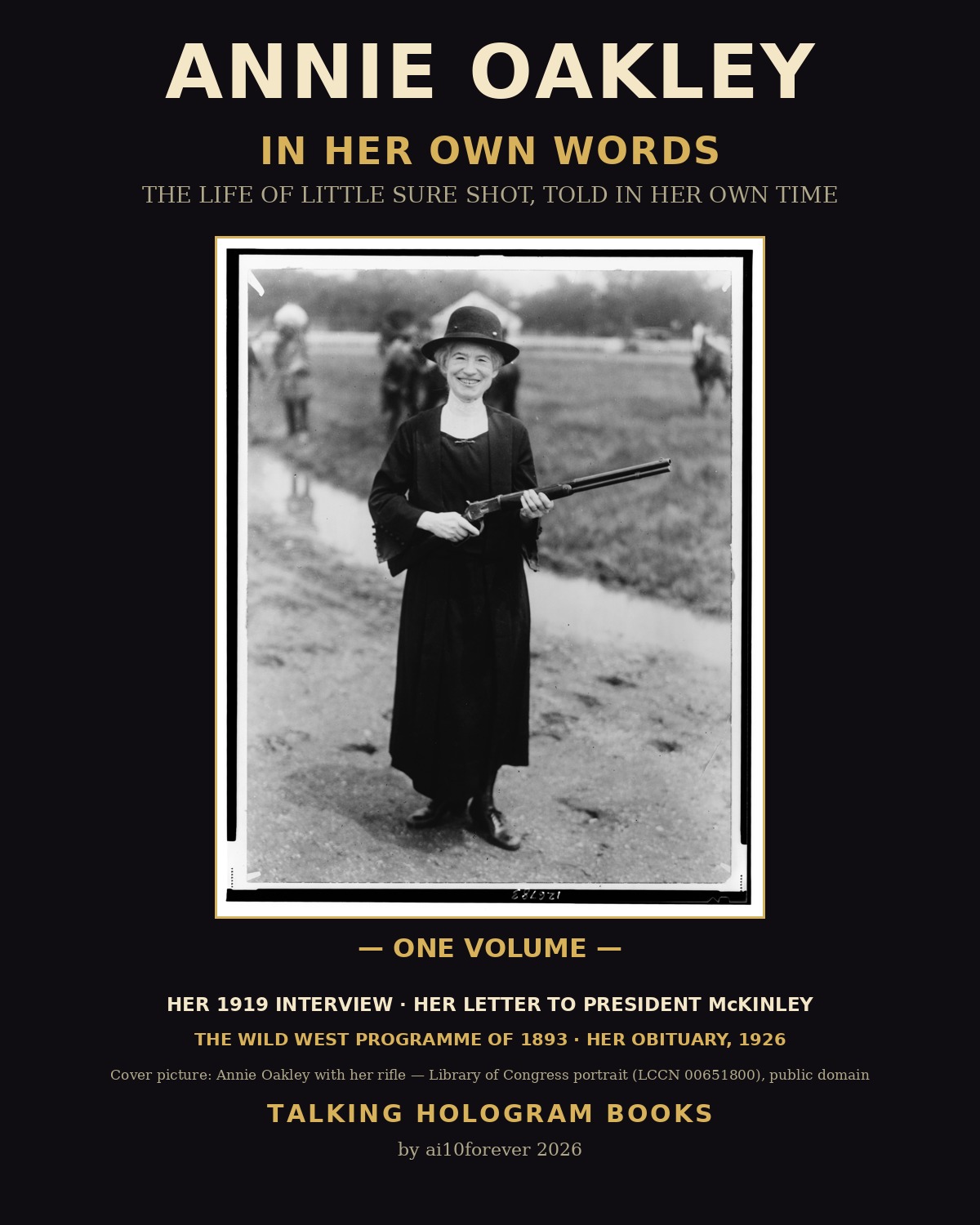
This is the book’s own stage: Annie Oakley herself — her portrait with her rifle, the Library of Congress photograph that stands on this book’s cover — stands on the stage and talks while her life is read aloud, in Amy’s voice, and the photographs of her own time pass behind her: the medal portrait of 1899, herself before her tent, her mirror shot, Pinehurst in her later years. This preview rides the stage, then hears Amy read the opening of the interview of 1919 — her life in her own telling — fresh. The book is honest about its own shape, on its face: the fifteen articles of her serialized autobiography were searched for across the open newspaper record and could not be obtained — they are named absent in the book, and nothing stands here under their name. The bookstore barcode rides the preview — scan any moment to come back to this bookstore.
Press Next to see everything that is inside the whole book.
Preview · Page 2 of 2
What’s Inside
- Her life, in the paper of her own time, whole: the Disclaimer — A Word Before the Book — then the Wild West programme of 1893 that introduced her to the world, her letter to President McKinley of April 1898 offering a company of fifty lady sharp shooters, the newspaper interview of 1919 that carries her life in her own telling, and the Associated Press obituary of 1926 that closed her story — legend lines and all, labeled as legend where they grew.
- About 27 minutes of narration — Amy reads the whole book aloud, page by page, in a reading room you can follow with your eyes, while Annie stands talking on the stage.
- The book’s pictures — nine photographs of her own time: the medal portrait of 1899, the cabinet portraits of her early show years, the Glasgow portrait of 1891, herself before her tent about 1889, the White portrait of 1903, her mirror shot, and Pinehurst in her later years — each captioned as its record dates it.
Annie Oakley was born Phoebe Ann Mosey in Darke County, Ohio, on August 13, 1860, and died at Greenville, Ohio, on November 3, 1926 — and her hundred years were completed on November 3, 2026, days before this book was made: she is read now because the century has run, and not a day before it had. The fifteen articles of her serialized autobiography (1925–26) are not in this book — they were searched for in the newspaper runs open to this house and could not be obtained, and the book names them absent on its face rather than putting anything in their place. The 1919 interview is read as the document it is, from the Yorkville Enquirer of September 5, 1919, the reporter’s frame and her quoted speech together. The music under the reading is “Silver Threads Among the Gold,” sung by Elsie Baker in the Victor recording of June 4, 1912, kept low beneath the voice. The narration is a synthesized reading (Piper — Amy) of these texts, made for this edition. Editor: Franklin Langston.
franklinlangston.gumroad.com/l/oqpkyjl

Point a camera at this barcode to come straight back to this bookstore — and pass it on.