Preview · Page 1 of 3
Meet the Book
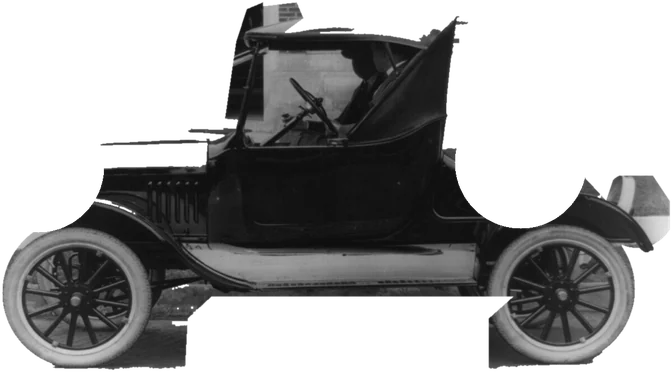
Watch her — the Model T drives out of the book, across the page, and parks back home. Tap her to step inside the book.
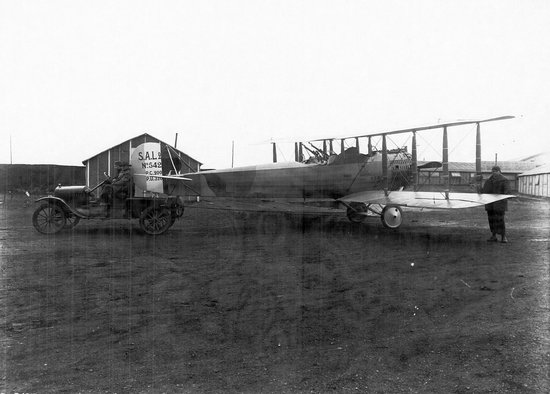
This is the book's own stage: Henry Ford stands and reads his book aloud — the first 72 seconds of Chapter XII, Money — Master or Servant?, over the book's 36-second stage loop, played twice, with period photographs behind him: a Fordson at war work at Orly, Henry Ford Hospital, Ford's own Shay locomotive, Dearborn from the air, the little Ford Flivver, and a Ford Trimotor. The narrator is Ford himself, from his real January 1922 photograph. The barcode rides every frame — scan any moment to come back to this bookstore.
“In December, 1920, business the country over was marking time..”
That is how Volume Two opens — December 1920, the plants closed, the money men circling — and under the stage, the little Model T drives out of the book itself, across the page, and parks back in. Press Next to step into the middle of the book, where the Fordson tractor is being born.
Preview · Page 2 of 3
From the Middle — Chapter XIV — The Tractor and Power Farming
HENRY FORD
The tractor came first in Ford's mind — before the motor car, there were the farm engines: “The planning of the tractor really antedated that of the motor car. Out on the farm my first experiments were with tractors, and it will be remembered that I was employed for some time by a manufacturer of steam tractors--the big heavy road and thresher engines.” Ford tells it himself, in his own words, exactly as his 1922 book gives them — how the Fordson was planned on the farm, and how five thousand of them crossed the ocean to plough England through a war.
Press Next to see everything that is inside the whole book.
Preview · Page 3 of 3
What’s Inside
- Chapters XII–XIX, complete — the book finished: 35,878 words, Ford's own text exactly as he published it in 1922 — money, master or servant?; why be poor?; the tractor and power farming; why charity?; the railroads; things in general; democracy and industry; and what we may expect — closing with the book's own printed last line, THE BOOK ENDS. (Volume One carries the Introduction and Chapters I–XI.)
- 3 hours 35 minutes of narration — Henry Ford himself stands on the stage and reads his own book aloud, chapter by chapter, in a reading room you can follow with your eyes.
- 31 period pictures — the Fordson at war work and at the plough on two continents, Henry Ford Hospital, Ford's own Shay locomotive, Dearborn from the air, and the flying machines Ford expected in 1922: the Flivver and the Trimotors. Every picture is public domain, each captioned with its source — and not one of them repeats a picture from Volume One.
- Kept honest, as Ford kept his accounts: the Model T was not the first car ever built — it was the first automobile ordinary people could afford, the car that put the world on wheels. This is Ford's own account of how that happened.
- The barcode rides every stage frame — scan any moment to come back to this bookstore.
This is the public-domain text of Henry Ford with Samuel Crowther's My Life and Work (1922; Project Gutenberg transcription #7213), presented as a talking hologram book, with all modern editorial matter removed and Ford's spelling untouched. The narration is a performed reading of that public-domain text, made for this edition. The narrator on the stage is Henry Ford himself, from a press photograph published in January 1922 — Ford in bowler hat and overcoat in a railway carriage doorway (Agence Rol / Keystone, via the Bibliothèque nationale de France) — a photograph of the man, not a painting or a rendering — and the book says so plainly in its disclaimer, which stands first, before the book begins. Editor: Franklin Langston.
franklinlangston.gumroad.com/l/ikpvvb

Point a camera at this barcode to come straight back to this bookstore — and pass it on.