Preview · Page 1 of 2
Meet the Book
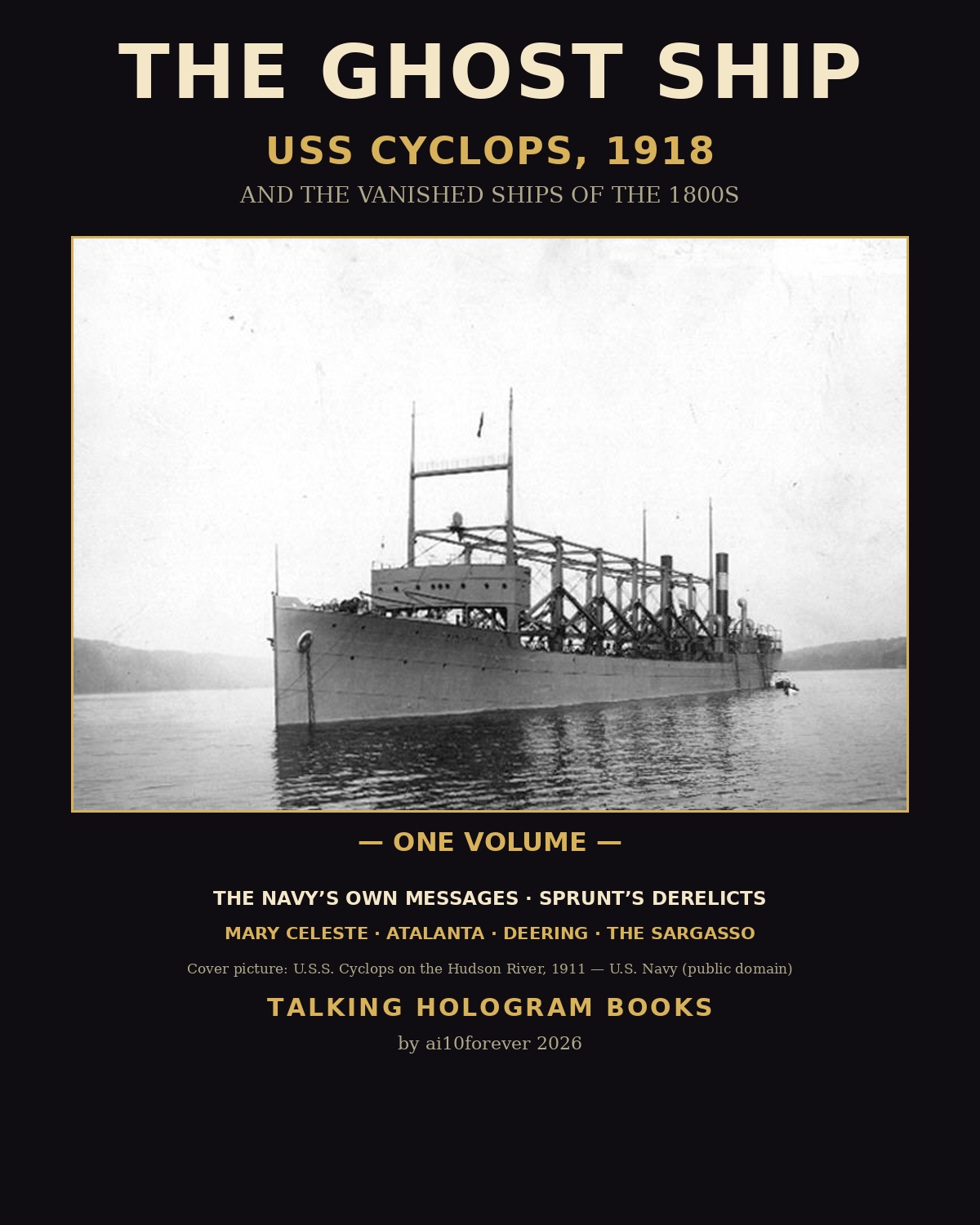
This is the book’s own stage: the Cyclops herself — her photograph on the Hudson River in 1911 and her own general plans from the Navy’s files — and, as their chapters come, the ships that witness with her, while a Reader at his desk, an unidentified man in a photograph of the time, captioned as no one but the Reader, reads the record aloud in Alan’s voice. This preview rides the stage, then hears Alan read the opening of James Sprunt’s Derelicts — the passage that sets the Cyclops at the head of the modern disappearances — fresh, whole. Two roads run through the Cyclops chapter and are kept apart and labeled where they stand: the published record, and testimony from the Navy’s own investigation file. The name Bermuda Triangle is never used in this book — it was coined in 1964, long after every loss in these pages. The bookstore barcode rides the preview — scan any moment to come back to this bookstore.
Press Next to see everything that is inside the whole book.
Preview · Page 2 of 2
What’s Inside
- The record, whole: the Disclaimer — then The Cyclops, 1918, in Sprunt’s Derelicts (1920) carrying the Navy’s own messages word for word, with a labeled TESTIMONY block from the investigation file itself: Captain Worley’s last port message, the American consul’s cable from Barbados, the Navy’s telegram to the families, and the Office of Naval Intelligence’s own summation — The Derelicts, Sprunt’s frame of marine wanderers, lost liners and the causes of loss — the Mary Celeste, 1872, in the surveyor’s sworn report to the Gibraltar court — Atalanta, 1880, in the conclusion of the committee that inquired into her loss, as Parliament heard it — the Deering, 1921, in the State Department’s own statement, her owner’s word, and the exposure of her famous bottle message — and the brig Polly in the Sargasso, 1811–12.
- About 2.4 hours of narration — Alan reads the whole book aloud, page by page, in a reading room you can follow with your eyes — the reading room carries every section’s full text — while the ships themselves stand on the stage, each document captioned with its real writer, office and date as it is read.
- The book’s pictures — ten public-domain photographs, plans and engravings: the Cyclops on the Hudson in 1911 and her own general plans, the Mary Celeste as the Amazon in 1861 with her captain and an engraving of her finding, H.M.S. Atalanta under sail, the Deering at her launch and as she was found, and the Sargasso weed itself.
This book is a book of vanished ships, and it says so on its face. The Cyclops was a naval collier in the service of the United States in the First World War, but her loss is told here as the disappearance it was, and not as a battle: the Navy’s own Office of Naval Intelligence investigated her disappearance for years, and investigated the war theories seriously — that a German submarine or raider sank her, and that her German-born captain betrayed her — and found no evidence for any of it; the investigation’s own summation stands in the book as it was written: “Many theories have been advanced, but none that satisfactorily accounts for her disappearance.” What could not be obtained is named absent, on the book’s face: the Atalanta inquiry’s full report — the committee’s conclusion as Parliament heard it stands in its place — and the Ellen Austin, who has no document of her own time at all. The famous account of the Mary Celeste in the Cornhill Magazine of 1884, which invented the details most repeated since, was a work of fiction by Arthur Conan Doyle, and it is not read here; the court record of 1872–73 is read instead. The music under the reading is Sousa’s Hands Across the Sea, of 1899, in the Columbia Orchestra’s recording of 1908, kept low beneath the voice. The narration is a synthesized reading (Piper — Alan) of these texts, made for this edition. Editor: Franklin Langston.
franklinlangston.gumroad.com/l/herkuo

Point a camera at this barcode to come straight back to this bookstore — and pass it on.