Preview · Page 1 of 2
Meet the Book
This is the book's own stage: C. G. Schillings — in the frontispiece portrait of his own book, photographed by Nicola Perscheid — stands on the stage, while the first journeys to Kilimanjaro are read aloud in English, in Alan's voice: Rebmann's first sight of the snows (1848), New's climb to the snowline (1871), and Thomson's classic approach through Masai country (1883). The bookstore barcode rides every frame — scan any moment to come back to this bookstore.
Press Next to see everything that is inside the whole book.
Preview · Page 2 of 2
What’s Inside
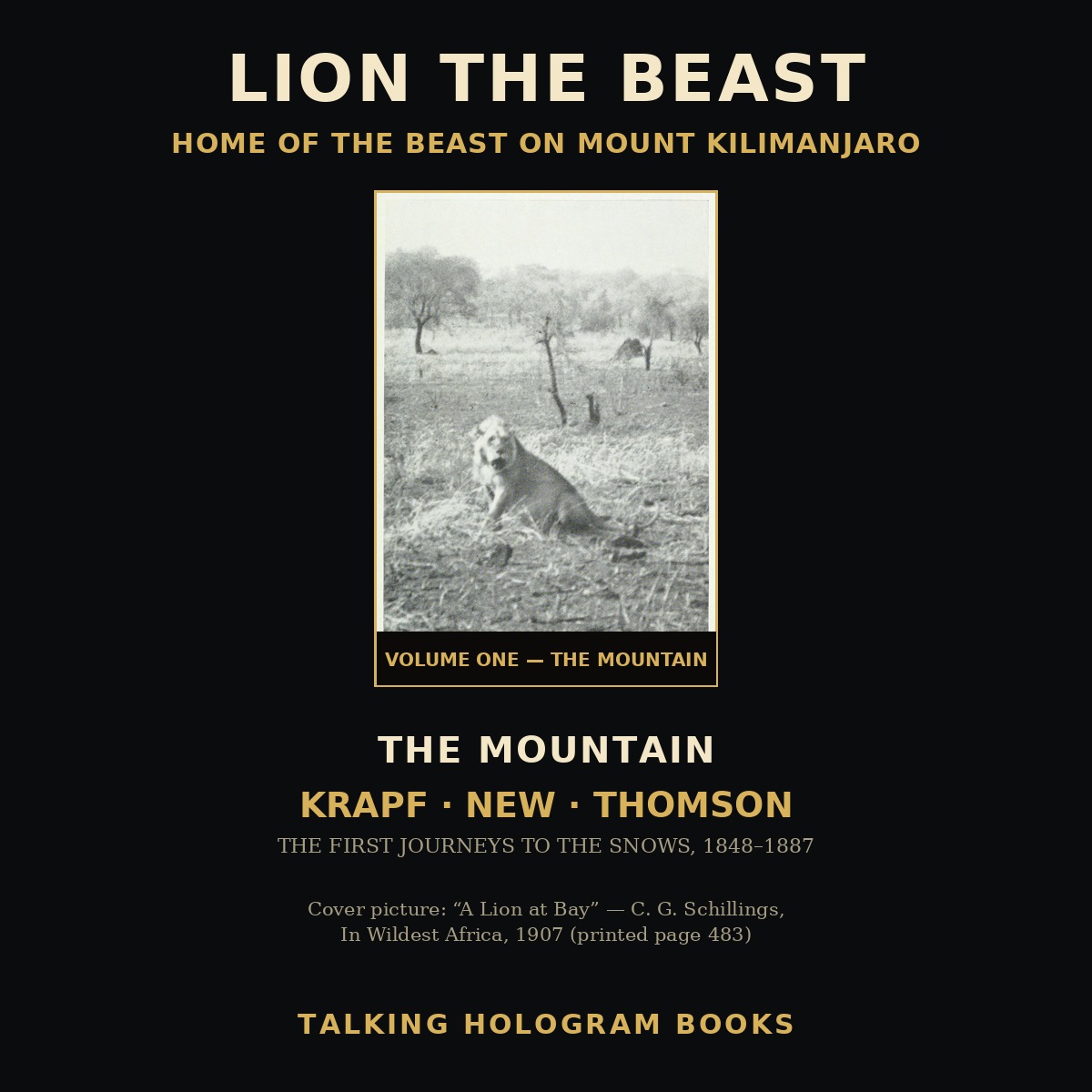
- The Mountain — the first journeys, in the authors' own words: Krapf's Travels (1860), carrying Rebmann's three journeys to Jagga (1848–49); New's Kilimanjaro chapters — the journey to Kilima Njaro, the ascent to the snowline, and the second attempt; and Thomson's approach chapters — To Taveta, and A Fortnight in a Forest Fastness.
- 7 hours 45 minutes of narration — Alan reads the book aloud in English, page by page, in a reading room you can follow with your eyes, while Schillings' portrait stands on the stage.
- Three journeys, one mountain — a missionary's journal carried home, a missionary-explorer's climb to the snowline, and a geologist's march through Masai country: the mountain enters written history in these pages, and each man tells it in his own words.
- The barcode rides every stage frame — scan any moment to come back to this bookstore.
These are the public-domain texts of Johann Ludwig Krapf's Travels, Researches, and Missionary Labours (1860), Charles New's Life, Wanderings, and Labours in Eastern Africa (1873), and Joseph Thomson's Through Masai Land (1887), presented as a talking hologram book in the authors' own words. This volume carries each book's Kilimanjaro movement — Rebmann's Jagga journeys in Krapf, New's Kilimanjaro chapters, and Thomson's approach chapters — and the book's opening disclaimer says so plainly rather than claim nothing was taken away. The stage figure is C. G. Schillings, whose In Wildest Africa fills Volumes Two and Three of this set. Every copy opens with an honest disclaimer that prints this house's one margin on its face: Schillings died in 1921, past the hundred-year line; his English translator, Frederic Whyte, died in 1941, fifteen years short of it — and the 1907 edition is public domain in the United States by its publication year. The narration is a synthesized English reading (Piper — Alan) of these texts, made for this edition. Editor: Franklin Langston.
franklinlangston.gumroad.com/l/ctntyfw

Point a camera at this barcode to come straight back to this bookstore — and pass it on.