Preview · Page 1 of 2
Meet the Book
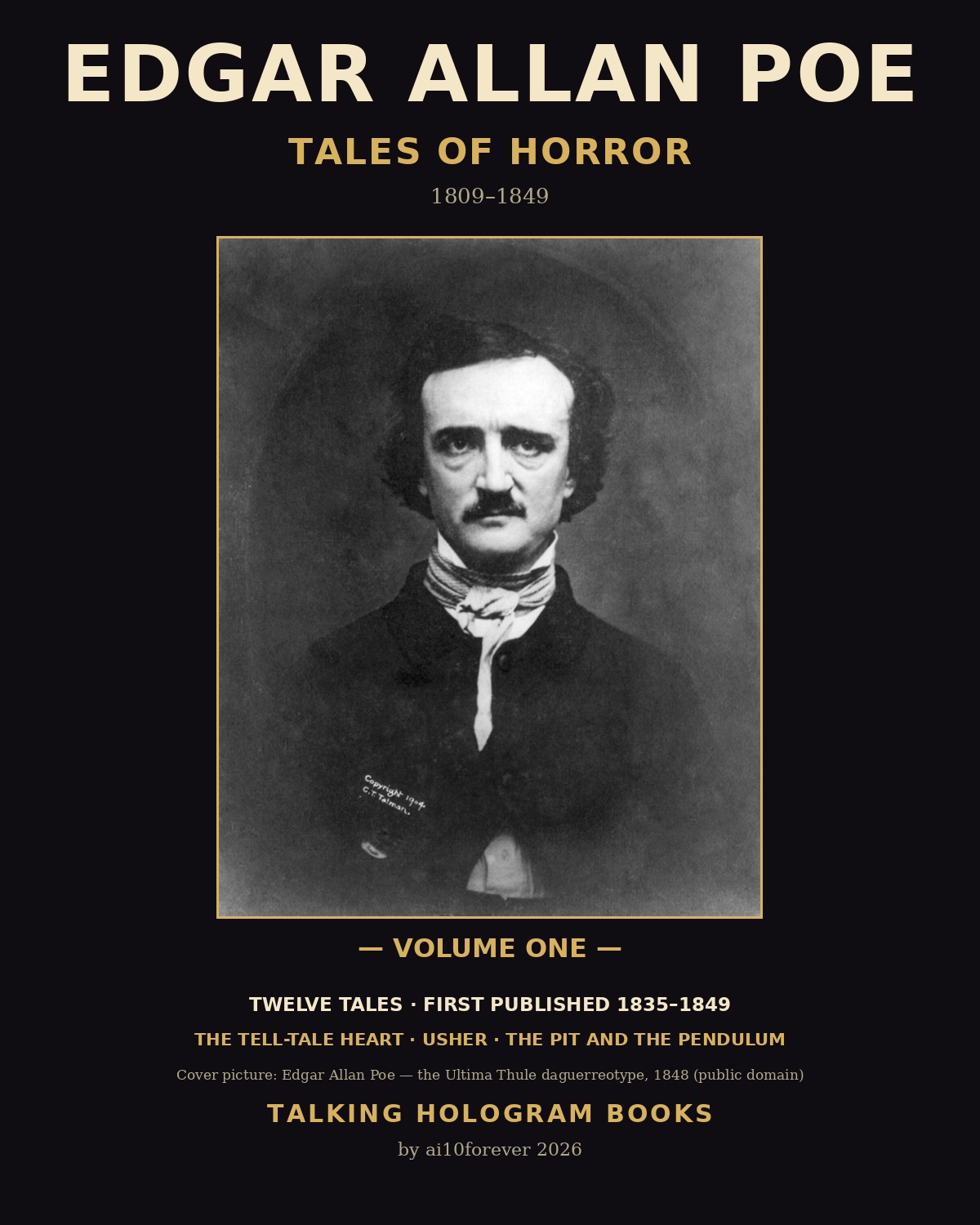
This is the book’s own stage: Edgar Allan Poe himself — from the daguerreotype taken at Providence in November 1848, less than a year before his death — stands on the stage while his tales are read aloud, in Alan’s voice. This preview rides the Usher stage, then hears Alan read the opening of “The Tell-Tale Heart” fresh. These are stories — works of imagination, invented horrors — and the book says so plainly, on its face: no man in them lived, no house in them stood, and the terror is the point of the telling. The bookstore barcode rides the preview — scan any moment to come back to this bookstore.
Press Next to see everything that is inside the whole book.
Preview · Page 2 of 2
What’s Inside
- Twelve tales of horror, whole: the Disclaimer — A Word Before the Book — then The Fall of the House of Usher, William Wilson, Ligeia, The Pit and the Pendulum, The Premature Burial, The Black Cat, Hop-Frog, The Facts in the Case of M. Valdemar, Berenice, The Masque of the Red Death, The Cask of Amontillado, and The Tell-Tale Heart — first published between 1835 and 1849.
- About 5.5 hours of narration — Alan reads Poe’s own words aloud, page by page, in a reading room you can follow with your eyes, while Poe himself stands talking on the stage.
- The book’s pictures — the Ultima Thule daguerreotype of 1848, the “Annie” daguerreotype of 1849, Gustave Doré’s plates for “The Raven,” and James Carling’s drawings made in rivalry with them.
- THE SET IS COMPLETE — ALL THREE VOLUMES — The Poems and Visions: “The Raven,” all the poems of his later life and manhood, and the visionary tales. Volume Two — Tales of Mystery and the Macabre — is out now.
This book is a book of stories, and it says so on its face. Edgar Allan Poe was born in Boston on January 19, 1809, and died in Baltimore on October 7, 1849 — one hundred and seventy-seven years ago. The texts follow The Works of Edgar Allan Poe in the Raven Edition (1903), as carried on Project Gutenberg, with the best-known tales checked against early separate printings before they were staged; the one weakness of that edition — that its text descends in part through the edition of Rufus Griswold, who altered what he touched — is named in the book’s own disclaimer, up front, where it belongs. The music under the reading is Saint-Saëns’ Danse macabre, of 1874, in a recording of 1925, kept low beneath the voice. The narration is a synthesized reading (Piper — Alan) of that text, made for this edition. Editor: Franklin Langston.
franklinlangston.gumroad.com/l/rprym

Point a camera at this barcode to come straight back to this bookstore — and pass it on.