Preview · Page 1 of 2
Meet the Book
This is the book’s own stage: Edgar Allan Poe himself — from the daguerreotype taken at Providence in November 1848, less than a year before his death — stands on the stage while his tales are read aloud, in Alan’s voice. This preview rides the stage, then hears Alan read the opening of “The Gold-Bug” fresh. These are stories — works of imagination, invented mysteries and terrors — and the book says so plainly, on its face: no man in them lived, no gold in them was ever buried, and the wonder is the point of the telling. The bookstore barcode rides the preview — scan any moment to come back to this bookstore.
Press Next to see everything that is inside the whole book.
Preview · Page 2 of 2
What’s Inside
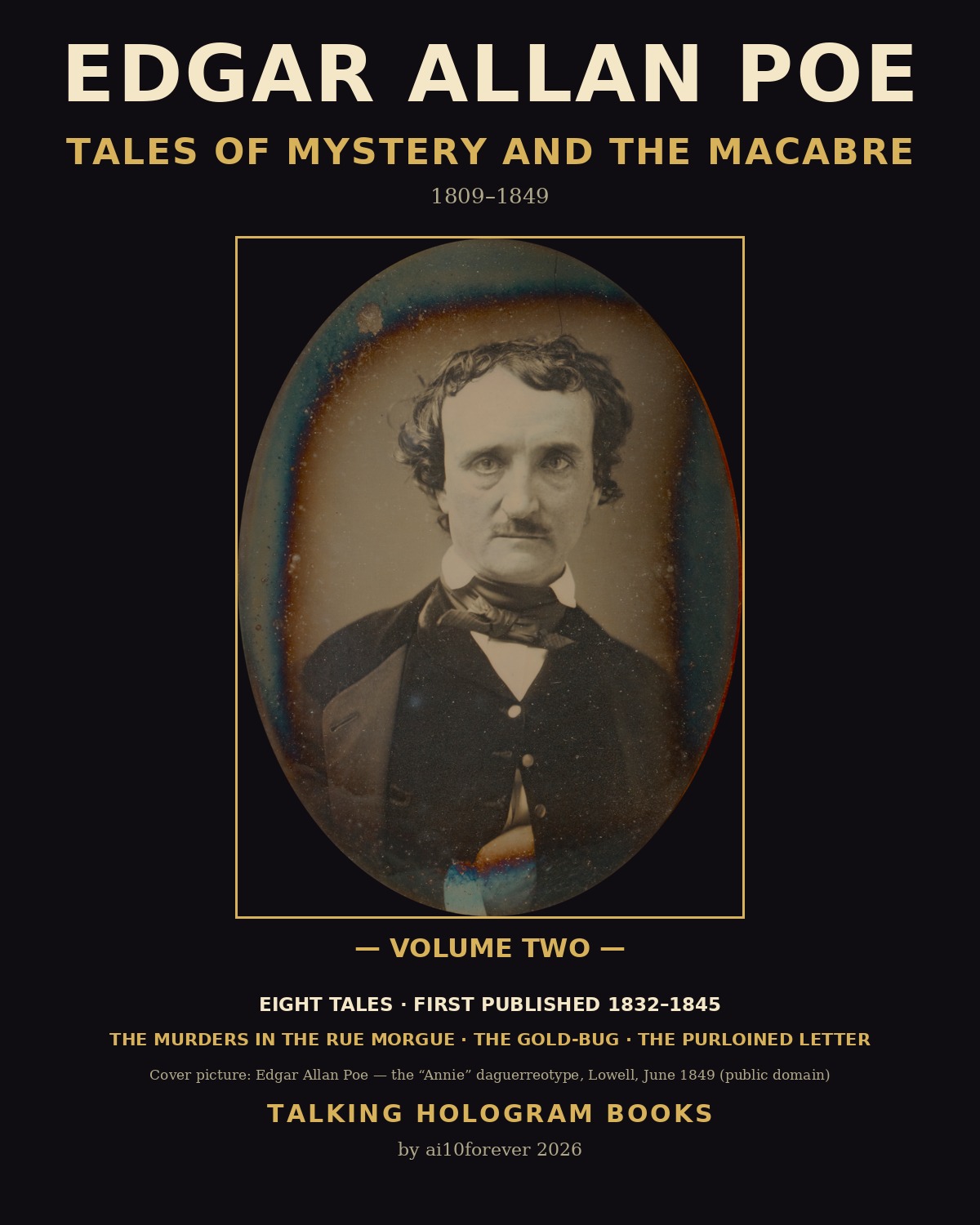
- Eight tales of mystery and the macabre, whole: the Disclaimer — A Word Before the Book — then The Murders in the Rue Morgue, The Gold-Bug, The Purloined Letter, A Descent into the Maelström, The Assignation, MS. Found in a Bottle, Metzengerstein, and The Imp of the Perverse — first published between 1832 and 1845.
- About 5.6 hours of narration — Alan reads Poe’s own words aloud, page by page, in a reading room you can follow with your eyes, while Poe himself stands talking on the stage.
- The book’s pictures — the “Annie” daguerreotype of 1849, the Ultima Thule daguerreotype of 1848, Gustave Doré’s plates for “The Raven,” James Carling’s drawings made in rivalry with them, and Édouard Manet’s lithographs for the French “Raven” of 1875.
- THE SET IS COMPLETE — ALL THREE VOLUMES — The Poems and Visions: “The Raven,” all the poems of his later life and manhood, and the visionary tales.
This book is a book of stories, and it says so on its face. Edgar Allan Poe was born in Boston on January 19, 1809, and died in Baltimore on October 7, 1849 — one hundred and seventy-seven years ago. The texts follow The Works of Edgar Allan Poe in the Raven Edition (1903), as carried on Project Gutenberg, with the best-known tales checked against early separate printings before they were staged; the one weakness of that edition — that its text descends in part through the edition of Rufus Griswold, who altered what he touched — is named in the book’s own disclaimer, up front, where it belongs. The middle Dupin case, “The Mystery of Marie Rogêt,” is not in this volume, and the disclaimer names its absence, so nothing famous is silently dropped. The music under the reading is Saint-Saëns’ Danse macabre, of 1874, in a recording of 1925, kept low beneath the voice. The narration is a synthesized reading (Piper — Alan) of that text, made for this edition. Editor: Franklin Langston.
franklinlangston.gumroad.com/l/osuyf

Point a camera at this barcode to come straight back to this bookstore — and pass it on.