Preview · Page 1 of 2
Meet the Book
This is the book’s own stage: Vlad III himself — from the portrait at Ambras Castle, painted about 1560 after a lost original from his lifetime — stands on the stage while the witnesses around his name are read aloud, in Alan’s voice. First comes the case for the prosecution: the German pamphlet of 1463 — the atrocity stories told by Vlad’s enemies, printed at Nuremberg in 1488 — given here as propaganda, in a new English translation made for this edition, because no public-domain English translation exists. Then Samuelson’s history chapter of 1882, doubt and all, and Gerard’s chapters of 1888 on the death-customs and superstitions of the country, where the nosferatu walks — Gerard never names Vlad, and this book says so. The bookstore barcode rides the preview — scan any moment to come back to this bookstore.
Press Next to see everything that is inside the whole book.
Preview · Page 2 of 2
What’s Inside
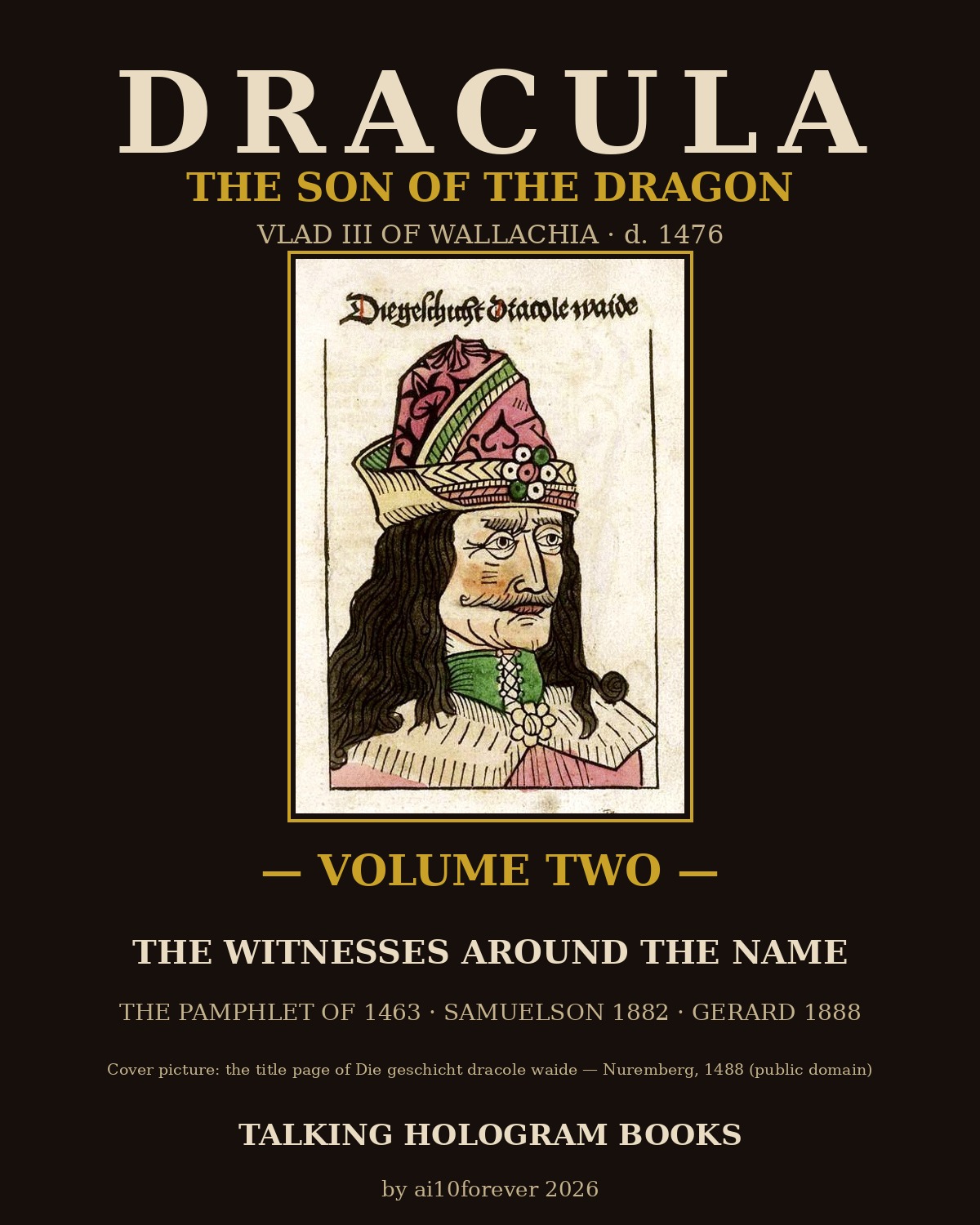
- The German Pamphlet of 1463, whole: Die geschicht dracole waide, printed at Nuremberg in 1488 — the opening, all thirty-one episodes, and the print’s own colophon — the enemies’ account, in a new English translation made for this edition.
- Samuelson’s history chapter, whole: James Samuelson, Roumania Past and Present (1882), Chapter XI — Parts I–VI with his footnotes in place, and Bolentineanu’s poems of Mircea and Stephen in Samuelson’s translation.
- Gerard’s chapters, whole: Emily Gerard, The Land Beyond the Forest (1888) — Chapter XXV, Death and Burial — Vampires and Were-Wolves, where the nosferatu passage stands; Chapter XXVI, Roumanian Superstition — Days and Hours; and Chapter XXVII, Roumanian Superstition — Continued, with her footnotes as printed.
- About 2.0 hours of narration — Alan reads the witnesses aloud, page by page, in a reading room you can follow with your eyes, while Vlad III stands talking on the stage.
- The book’s pictures — the 1488 pamphlet title page (the oldest portrait of him that survives), the 1499 title page, dining among the impaled, the title leaf of the 1488 print itself, and the Ambras portrait, cross behind him on the stage.
- THE SET IS COMPLETE — BOTH VOLUMES — Volume One is Wilkinson’s Account of Wallachia and Moldavia (1820), whole — the book Bram Stoker took the name Dracula from. With this volume the record around the name stands complete.
This book is about a man, not a monster. Vlad III of Wallachia — Dracula, “son of the dragon,” so called after his father — was born about 1431 and died in 1476 or 1477. No life of him was ever written in English in the old time, so this book is built the way the evidence stands: from witnesses, and every witness is named. This second volume gathers the witnesses around the name: the German pamphlet of 1463, the atrocity stories told by his enemies, given here as propaganda, in a new English translation made for this edition — an exception to this house’s rule, stated plainly on the book’s face, as it was stated on the Hungary books; James Samuelson’s history chapter (1882), the fullest old English sketch of Vlad, doubt and all; and Emily Gerard’s chapters on Roumanian death-customs and superstition (1888), where the nosferatu walks. The record is two-sided, and this book does not settle it. The narration is a synthesized reading (Piper — Alan) of these texts, made for this edition. Editor: Franklin Langston.
franklinlangston.gumroad.com/l/kwfedz

Point a camera at this barcode to come straight back to this bookstore — and pass it on.